
For Iowa homeowners, protecting your electrical system from power surges is a smart investment. A whole‑house (or main panel) surge protector, installed at your service entrance, detects excessive voltage and diverts transient energy away from your home’s branch circuits, significantly reducing damage to TVs, computers, and appliances. However, it’s crucial to understand their limitations: while effective for common surges (utility switching, motor starts), they don’t eliminate every risk. These devices have clear boundaries, allow some residual voltage, and their internal components (Metal Oxide Varistors or MOVs) degrade over time. This article explains surge causes, how whole‑house protectors function, why they can be overwhelmed by direct lightning or long‑duration events, and provides a practical layered protection plan. It also guides on devices needing extra point‑of‑use protection or a UPS, installation costs, and maintenance. Our goal is to offer clear, actionable advice for Iowa homeowners to prioritize spending and know when to call a licensed electrician for professional electrical panel surge protector installation.
What Causes Power Surges and How They Harm Your Home Electronics
A power surge is a brief, abnormal rise in voltage on an electrical line, dumping damaging energy into electronics and appliances. Surges originate both inside your home—from events like motor starts, compressor cycling, and large appliances switching on—and from external sources such as utility switching, lightning strikes, or downed power lines. Immediate consequences include blown power supplies or lost data; smaller, repeated surges cause invisible damage, shortening component life. Understanding surge origins helps focus protection efforts, as layered strategies prevent most common damage, though extreme external events may require more than a typical main panel SPD.
What Are the Main Surge Sources — Internal Versus External?
Most surges are generated internally and occur frequently from events like HVAC compressor starts, refrigerator motor cycling, and other large inductive loads. These create short, repeated spikes, high in instantaneous voltage but limited in total energy, leading to cumulative wear. External causes—utility switching, lightning-induced transients, and distribution line faults—are less common but carry much higher energy and current, often resulting in immediate, catastrophic failures. Industry data shows internal switching is more frequent, meaning main panel SPDs address common threats, while additional measures are prudent for rare, high-energy events.
How Do Surges Damage Electrical Panels and Connected Devices?
Surges cause rapid voltage overshoot that stresses insulation, heats conductors, and forces excessive current through semiconductors and power supplies. When transient energy exceeds a component’s breakdown threshold, immediate failure occurs. Lower-energy, repeated surges cause microscopic damage (junction migration, dielectric weakening, thermal cycling) that shortens service life. Even circuit breakers and panel parts can suffer localized heating or contact pitting, reducing safety margins. Since cumulative damage is often hidden until a later failure, proactive surge mitigation and monitoring are essential for protecting sensitive or costly equipment.
How Whole‑House Surge Protectors Work at Your Main Panel
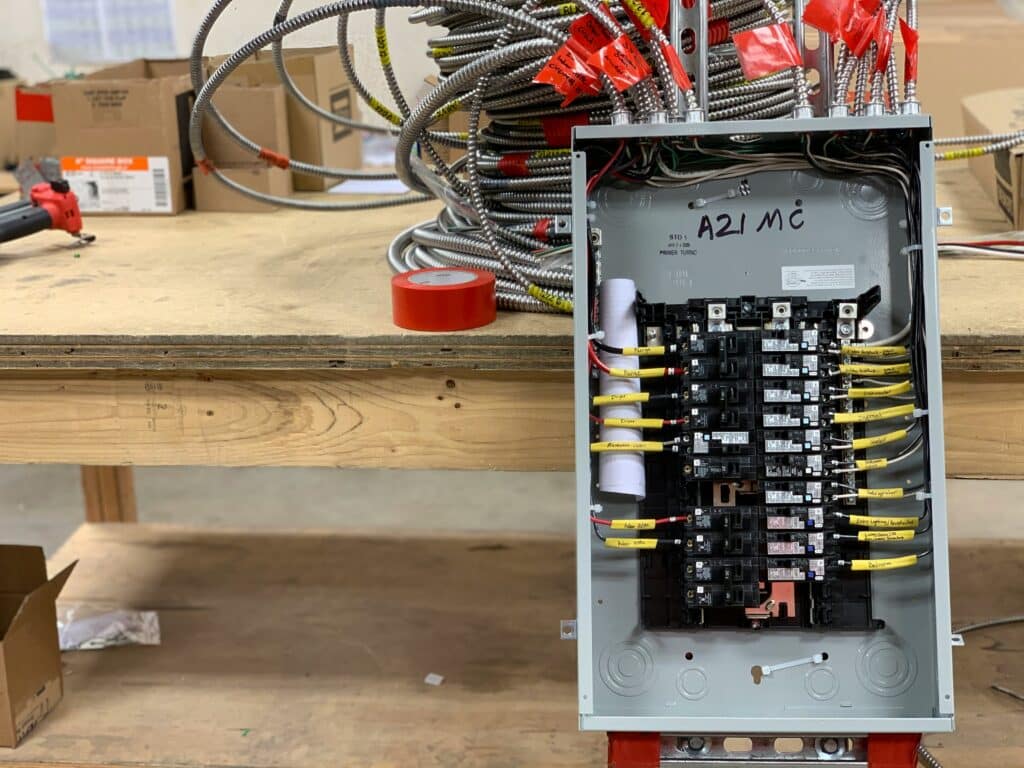
Whole‑house surge protectors mount at the service entrance or main panel, sensing overvoltage and diverting excess current to ground or neutral. They primarily use Metal Oxide Varistors (MOVs) to clamp voltage spikes. Key performance specifications include joule rating (total energy absorption capacity) and clamping voltage (the level at which the SPD begins conducting). By shunting surge current away from branch circuits, a service entrance SPD reduces the transient energy reaching downstream outlets and devices. Real‑world performance also depends on the protector’s design, grounding quality, and component aging. The table below compares common suppression components.
| Suppression Component | Role | Typical Rating / Behavior |
|---|---|---|
| Metal Oxide Varistor (MOV) | Clamps overvoltage by switching to a conductive state above its threshold, sending energy to ground | Rated by energy absorption (joules) and peak surge current; performance degrades with repeated events |
| Gas Discharge Tube (GDT) | Ionizes to form a low‑impedance path for very large transients, handling high current bursts | Handles very high surge currents but responds slower and may pass some residual voltage before firing |
| Series Reactance / Inductors | Limits the rate of current rise and smooths incoming transients when used in coordinated systems | Specified by impedance and thermal capacity; used alongside other devices |
| Hybrid (MOV + GDT) | Combines fast MOV clamping with high‑current GDT capacity for better lifecycle and lower residuals | Balances fast response and high energy handling for improved real‑world performance |
MOVs are common due to their speed and cost-effectiveness, but combining suppression types generally improves protection across various surge profiles.
What Do Metal Oxide Varistors (MOVs) Do and How Do They Fail?
Metal Oxide Varistors (MOVs) clamp voltage by rapidly changing resistance at high voltages; below their threshold, they act as an open circuit, but above it, they conduct and divert surge energy. Their quick reaction makes them standard in residential SPDs. However, MOVs absorb energy cumulatively, meaning each event consumes part of their capacity and can increase the residual voltage they allow to pass. Failure modes include thermal runaway (if overstressed without proper fusing) or slow degradation, raising let-through voltage and reducing protection. Quality products use multiple MOVs, thermal disconnects, and visual indicators to mitigate these risks.
How Do Joule Ratings and Clamping Voltage Affect SPD Performance?
The joule rating represents the SPD’s total energy absorption capacity, while clamping voltage is the level at which it begins to act. A higher joule rating means the device can absorb more cumulative energy before depletion, and a lower clamping voltage reduces stress on downstream equipment. Neither specification, however, guarantees immunity from extreme events like a direct lightning strike. For practical selection, look for UL 1449 compliance, choose a joule rating appropriate for your exposure, and prefer a clamping voltage low enough for your most sensitive equipment. Installation location, grounding quality, and coordinated point-of-use devices are as crucial as the spec sheet.
What Whole‑House SPDs Won’t Do — Their Critical Limitations
Whole‑house protectors reduce the magnitude of many transients, but they have clear limits. They can be overwhelmed by a direct lightning strike, pass harmful residual voltage, degrade over time, and do not protect data or coax lines without additional devices. SPDs are for transient suppression, not absorbing full lightning energy; their effectiveness ties directly to grounding and bonding quality. Repeated low-level surges slowly consume MOV capacity and raise residual voltage, increasing the chance of downstream damage even with an SPD installed. These limitations highlight why a layered protection strategy and targeted point-of-use defenses are essential for sensitive equipment.
Why a Whole‑House SPD Can’t Fully Stop a Direct Lightning Strike
Direct lightning can carry tens to hundreds of kiloamperes, far exceeding the energy a residential SPD can handle without catastrophic failure. Lightning also causes ground-potential rise, where the local earth voltage spikes, creating dangerous differences across grounding, neutral, and bonded systems, pushing transients into wiring and equipment. In Iowa, severe thunderstorms make this a significant concern. While whole-house SPDs help with indirect lightning, they don’t replace a full lightning protection system (air terminals, bonding, heavy grounding) for direct strikes. Homeowners in high-lightning areas should combine SPDs with structural lightning protection and prioritize point-of-use protection for their most valuable gear.
How Residual Voltage and Device Degradation Change Protection Over Time
Residual voltage is the small voltage remaining on a line after an SPD conducts a surge. While usually not immediately destructive, repeated exposure wears down sensitive electronics. As MOVs degrade, they clamp less effectively, increasing residual voltage and rendering the SPD ineffective, often without obvious external signs beyond a warning indicator or internal thermal damage. Factors like frequent switching events, poor grounding, high ambient temperatures, and living in storm-prone areas shorten SPD life and may necessitate earlier replacement. Regular inspection, scheduled testing after major storms, and conservative replacement timelines in high-risk regions ensure protection remains effective.
What a Layered Surge Protection Strategy Looks Like and Why It Matters
A layered strategy employs coordinated devices at the service entrance, subpanels, and point-of-use outlets to progressively reduce transients, catching any leftover energy before it reaches sensitive equipment. Install a Type 1 (service entrance) SPD at the main panel for bulk energy absorption, add Type 2 units at subpanels where beneficial, and use Type 3 point-of-use protectors at outlets to clamp residual voltage near the device. A UPS for critical electronics adds surge suppression, voltage regulation, and short-term backup power. Layering also extends to data and coax lines with inline protectors. Below is a quick breakdown of SPD types and their roles:
- Type 1 SPDs: Mounted at the service entrance or meter; handle large incoming transients and serve as the primary energy diversion point.
- Type 2 SPDs: Installed at the main panel or subpanels; protect branch circuits and coordinate with the Type 1 device.
- Type 3 SPDs: Point‑of‑use units (power strips, outlet protectors) that clamp residual voltage right at sensitive equipment.
- UPS (Uninterruptible Power Supply): Sits beside critical gear to provide surge suppression, voltage regulation, and short backup power during outages.
Combining SPD types and UPS units reduces both total surge energy and let-through voltage, providing stronger protection for an Iowa home.
How Whole‑House and Point‑of‑Use Protectors Work Together
A whole‑house SPD intercepts and shunts the bulk of upstream energy, lowering the peak of any transient entering your wiring. Point‑of‑use protectors then clamp remaining residual voltage directly at the outlet and handle data/coax entry points. Coordination is key: pair a reputable service entrance SPD (e.g., Eaton, Schneider Electric, or Leviton) with low-let-through point-of-use devices and data-line protectors, and add UPS units for equipment requiring clean, continuous power. For smart-home hubs, servers, and AV racks, a point-of-use unit with a low let-through voltage at the outlet is crucial. A licensed electrician can advise on spacing and coordination to prevent smaller devices from taking premature damage.
Which Devices Should Get Extra Localized Surge Protection?
Prioritize protection for high-value or sensitive items: desktop computers, NAS servers, smart-home hubs, home theater receivers, medical equipment, and HVAC control boards benefit most from point-of-use SPDs or UPS systems. Networked and coaxial equipment are vulnerable through data lines, so use inline protectors for Ethernet, coax, and phone lines. Hardwired appliances, like HVAC systems, are best protected with subpanel SPDs or dedicated hardwired point-of-use devices to safeguard control boards. Focus on equipment replacement cost and operational importance when deciding where to add layers of protection.
Costs and Professional Requirements for Whole‑House Surge Protector Installation
Total installed cost depends on the SPD chosen, panel accessibility, local labor rates in Iowa, and any necessary grounding or panel upgrades. Device prices range from budget Type 2 units to higher-spec Type 1 service entrance SPDs. Labor costs increase if an electrician must upgrade bonding, add grounding electrode conductors, or access the meter socket. Proper conductor sizing, correct bonding to the grounding electrode system, and NEC[2] adherence are essential for SPD performance and to prevent unsafe ground loops. A licensed electrician will evaluate your grounding system, as older Iowa homes often require upgrades for safe surge energy diversion.
Typical Cost Range for Whole‑House Surge Protector Installation
In Iowa, expect total installed costs to vary based on product quality and job complexity. Device prices for quality whole-house SPDs typically range from $150 to $500. Professional labor usually adds $200 to $500, depending on panel access and whether grounding upgrades are required. This places a reasonable total installed range around $350 to $1,000. Lower-cost units may save money upfront but often use smaller MOV arrays and offer shorter warranties. Higher-end products include better thermal disconnects, higher joule ratings, and visual indicators, which can justify the increased price in surge-prone areas. Always request itemized quotes to compare device cost, labor, and any grounding or panel work accurately.
Why Professional Installation and Proper Grounding Matter
Professional installation ensures the SPD is connected to an effective grounding electrode system using correctly sized conductors and proper bonding. This safely diverts surge energy without creating dangerous potential differences. Improper grounding, undersized conductors, or poor bonding can render an SPD ineffective or introduce new hazards like ground loops or energized equipment during transients. Licensed electricians in Iowa will verify NEC compliance, check that the SPD’s short-circuit ratings match the service equipment, and confirm thermal protection for MOVs. Ultimately, even the best SPD requires a solid grounding system to function correctly, and many older homes need upgrades that only a professional should perform.
How to Maintain Your Surge Protector and When to Replace It
Maintaining a whole‑house surge protector is straightforward: perform periodic visual checks, monitor status indicators, and schedule electrical testing after major surge events to confirm functionality. Since protection success is often invisible, a proactive maintenance plan (annual visual inspections, testing after storms/incidents) helps detect degradation. Keep a log of surge events, indicator status, and any changes in device behavior, and use conservative replacement timelines in high-exposure areas.
Common Signs That a Surge Protector Needs Replacement
Look for a persistent or fault indicator light, visible discoloration or charring, signs of overheating, or if the protector has taken a known large surge. While indicator lights are helpful, they are not infallible; some failures are internal with no external change. After any major storm or lightning strike, have an electrician inspect the SPD and consider replacement. If sensitive equipment begins failing more often or shows signs of power stress, the SPD may no longer be protecting effectively. When in doubt, treat major transients or thermal damage as clear reasons to replace the unit.
- Annual visual check: Inspect the SPD and panel for discoloration, loose connections, or unusual odors.
- Post‑event inspection: After lightning or a utility fault, call an electrician for testing, especially in storm‑prone Iowa.
- Indicator monitoring: Note any change in status lights and log surge events.
- Device replacement: Replace the SPD if indicators fail, after major surges, or per a conservative lifespan plan.
How Long Do Whole‑House Surge Protectors Typically Last?
Service life varies. Under moderate conditions, expect several years—commonly in the 5–10 year range. However, in surge-prone areas like parts of Iowa, life can be shorter due to repeated energy absorption and thermal stress. The frequency and magnitude of surges, ambient temperature, and grounding quality all affect real lifespan, so plan conservative replacement intervals and replace after major events. Manufacturer warranties offer a helpful baseline, but they often assume ideal grounding and conditions; use warranties as minimum guidance and rely on inspections and indicator signals to time replacements.
- Typical baseline: Expect multi‑year service but plan for periodic replacement.
- High‑risk adjustment: Shorten replacement intervals in storm‑prone or industrial areas.
- Warranty consideration: Treat warranty terms as a minimum baseline, not a definitive lifespan.
Frequently Asked Questions
- What additional measures protect sensitive electronics beyond a whole‑house SPD? Use point‑of‑use surge protectors for sensitive electronics like computers and home theaters. A UPS adds surge protection, voltage regulation, and short backup power for critical gear.
- How often should I test my surge protector? Test at least once a year, and more often in stormy areas. After significant surge events, have a licensed electrician inspect and test the SPD.
- Can I install a whole‑house surge protector myself? We strongly recommend hiring a licensed electrician. Proper installation requires correct grounding, code compliance, and correct sizing for safety and effectiveness.
- What should I do if my surge protector shows signs of damage? If you see discoloration, overheating, or a persistent fault indicator, replace the unit immediately. Always consult a licensed electrician for inspection and replacement.
- Are there recommended brands or models? Look for UL 1449 compliance[1]. Brands like Eaton, Schneider Electric, and Leviton are commonly recommended. Check joule rating, clamping voltage, thermal protection, and warranty.
Ready to Protect Your Iowa Home?
Don’t leave your valuable electronics vulnerable to power surges. Our licensed electricians provide expert surge protection solutions tailored for Iowa homeowners.
Conclusion
Whole‑house surge protectors are a vital layer of defense for Iowa homes, but they are not an impenetrable shield, especially against extreme events like direct lightning. A layered protection plan—combining a service entrance SPD with point‑of‑use devices, data/coax protectors, and UPS systems where needed—offers the best real‑world protection for your most valuable electronics. Don’t leave your gear exposed; take practical steps now to protect your home.
References: [1] UL 1449, Standard for Surge Protective Devices. Underwriters Laboratories. [2] National Electrical Code (NEC). National Fire Protection Association (NFPA).
