
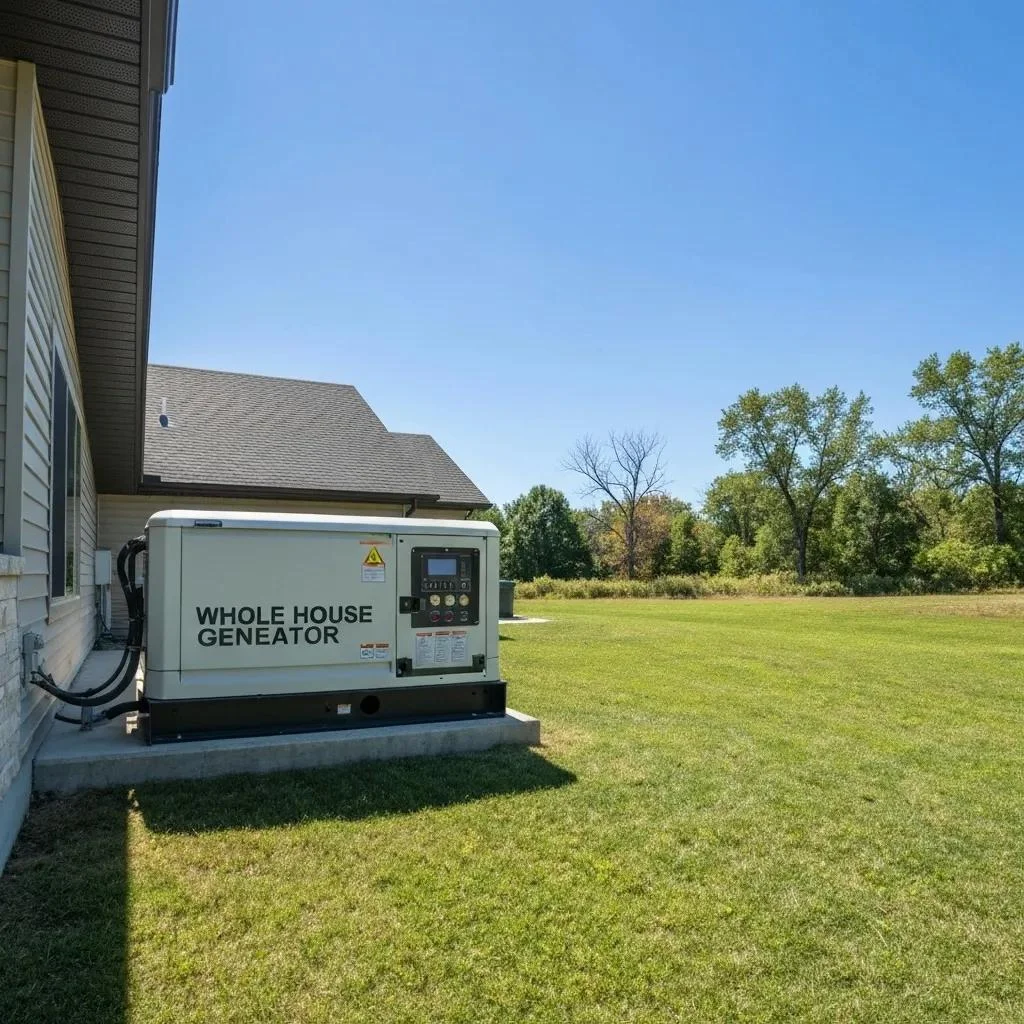
Your Guide to Sizing a Whole House Generator for Central Iowa Homes
Power disruptions in Central Iowa can really throw a wrench in your daily routine and even impact your safety. That’s why having a whole house generator that’s sized just right is key to keeping your home comfortable and secure. This guide will walk you through figuring out what’s essential versus what’s not, understanding watts and kilowatts, calculating your total power needs, comparing different generator types and fuel options, the importance of an automatic transfer switch, why you should call on licensed electricians like us at Rewired Iowa, and how to keep your system running smoothly. By the end, you’ll know exactly how to determine the right size whole house generator for your needs and when to reach out to Rewired Iowa for expert installation and service.
What Power Does Your Home Really Need: Essential vs. Non-Essential Loads?
To figure out your home’s power needs, we’ll break down your appliances into two groups: essential loads that keep you safe and comfortable, and non-essential loads that are more about convenience. This helps make sure your generator powers the most critical systems first, preventing overloads and saving on fuel. For instance, keeping your furnace and refrigerator running during a winter storm is a top priority.
What Are Essential Loads and Why Are They So Important?

Essential loads are the critical systems that keep your home safe and functional when the power grid goes down.
- Your furnace or boiler to prevent your home from freezing.
- Your refrigerator and freezer to keep food and important medicines safe.
- Your well pump or sump pump for essential water supply.
- Key lighting to help you move around safely.
- Any medical equipment you rely on, like oxygen concentrators.
By identifying these essential loads first, we ensure that your life-sustaining systems stay powered, which is the first step in accurately calculating your needs and ensuring your generator runs efficiently.
Essential vs. Non-Essential Loads: What’s the Difference?
Prioritizing essential loads—those that maintain safety and basic functions during an outage—is crucial for correctly sizing your generator. These include vital systems like your furnace, refrigerator, and any necessary medical equipment, ensuring that your most important systems remain operational.
Which Appliances Are Considered Non-Essential Loads?
Non-essential loads are those that add to your comfort but can be turned off to manage your generator’s capacity and fuel usage.
- Extra air conditioners or supplemental heating units.
- Hot tubs or spa equipment.
- Your electric oven or range for full cooking capabilities.
- Pool pumps and outdoor lighting.
- Entertainment systems like TVs and gaming consoles.
Knowing which appliances fall into the non-essential category allows you to decide whether to exclude them from your primary generator sizing or add them if your generator has the extra capacity, guiding you toward the most efficient generator choice.
How Do I Put Together a Complete Appliance Wattage List?
Start by listing every appliance you’d want to run during an outage. Make sure to note both the running watts (how much power it uses continuously) and the starting watts (the extra power needed to kick it on) from the appliance’s label or manual. For example, a refrigerator might use 1,500 watts while running but need 2,000 watts to start up. Use this list to prioritize your essential loads, which will form the basis for your total power requirements.
Once you have your detailed wattage list, you’ll be ready to understand generator power units and convert your appliance data into the necessary kW or kVA figures.
Understanding Generator Power Units: Watts, Kilowatts (kW), and Kilovolt-Amperes (kVA)
Proper generator sizing relies on a clear understanding of power units. Running and starting watts tell us what your appliances need, while kW and kVA measure the generator’s output. Getting these right means you won’t end up with a generator that’s too small or paying for more power than you need. For instance, knowing that 10 kW is the same as 10,000 W helps you pick a generator that’s rated higher than your total calculated load.
What’s the Difference Between Running Watts and Starting Watts?
Running watts are the steady amount of power an appliance uses while it’s on. Starting watts, on the other hand, are the brief surge of power needed to get motors or compressors going. A well pump, for example, might use 800 watts continuously but need a 2,000-watt boost to start. Calculating both ensures your generator can handle these power spikes without shutting down, providing seamless operation when it’s under load.
How Can I Find Appliance Wattage Ratings Accurately?
You can usually find wattage ratings on the appliance’s data plate, in the manufacturer’s manual, or on online specification sheets. If a label only shows amps instead of watts, you can calculate watts by multiplying amps by the voltage (typically 120 V or 240 V). For example, a device drawing 7 amps at 120 volts uses 840 watts. Getting these wattage figures right prevents oversights that could affect your generator’s performance.
Why Are Kilowatts (kW) and Kilovolt-Amperes (kVA) Important for Generator Sizing?
Kilowatts (kW) measure the actual power your generator can deliver to run your appliances. Kilovolt-amperes (kVA), however, represent the apparent power, which includes the power factor. A generator rated at 20 kVA with a 0.8 power factor actually delivers 16 kW of usable power. Understanding both units is crucial to ensure you select a generator whose kVA rating can handle starting surges and whose kW rating meets your continuous power demands.
How Do I Calculate Total Power Requirements for My Whole House Generator?
To calculate your total power needs, you’ll combine your appliance wattage list with a safety buffer and consider any limitations of your electrical service panel. This process leads you to the optimal generator size, preventing the issues of undersized units that overload or oversized ones that waste fuel and money.
What Is the Simple Summation Method for Load Calculation?
Here’s a straightforward way to estimate your total running and peak watts:
- Add up the running wattages for all the essential appliances you plan to power.
- Identify the single highest starting wattage among those essential items.
- Add that highest starting wattage to your total running wattage.
For example, if your essential appliances add up to 7,500 running watts and the highest starting wattage is 2,000 watts, you’ll need a generator capable of at least 9,500 watts. This method gives you a clear baseline for your minimum generator capacity.
How Much Safety Margin Should I Add to My Load Calculation?
It’s wise to add a 20–25 percent safety margin to your calculated load. This buffer accounts for potential future appliance additions, variations in power factor, and unexpected peak demands. If your calculation comes out to 9,500 watts, adding 20 percent brings you to 11,400 watts. This extra capacity ensures reliable operation under various conditions and helps extend your generator’s lifespan by preventing it from constantly running at its maximum output.
How Does My Home’s Electrical Service (e.g., 200 Amp) Affect Generator Size?
A 200-amp electrical service panel can theoretically handle up to 48 kW at 240 volts. However, when installing whole house generators, we typically recommend matching the generator’s kW capacity to your panel’s maximum continuous load rather than its absolute peak capacity. For most homes with a 200-amp service, a 15–22 kW standby generator is usually sufficient to power all critical circuits and even some comfort loads without overloading the panel.
Generator Sizing and Electrical Service: What You Need to Know
The size of your home’s electrical service panel plays a significant role in determining the appropriate size for your whole-house generator. For instance, a 200-amp service panel can manage a substantial load, but it’s best practice to match the generator’s kW capacity to the panel’s maximum continuous load, rather than its theoretical peak, to ensure the system operates safely and efficiently.
This guidance is important because it explains how to properly match your generator’s capacity to your home’s electrical service, ensuring safe and efficient operation.
Where Can I Use an Interactive Generator Sizing Calculator?
You can find specialized online tools designed to help you through the process. These calculators guide you in selecting loads, inputting wattage figures, and applying safety margins to provide a recommended kW rating. Using these tools can simplify the process and help validate your own calculations, allowing you to quickly compare results before consulting a professional for a final assessment.
Which Generator Types and Fuel Options Are Best for Your Central Iowa Needs?
Choosing between standby and portable generators, and deciding on natural gas, propane, diesel, or dual-fuel units, depends on factors like availability, cost, maintenance needs, and performance expectations in Central Iowa. Matching the generator type and fuel to your local infrastructure and how you plan to use it will ensure you have reliable power when you need it most.
What Are the Differences Between Standby and Portable Generators?
Standby and portable generators serve different purposes:
| Generator Type | Key Feature | Primary Benefit |
|---|---|---|
| Standby Generator | Permanently installed at your home | Automatic startup and whole-house power coverage |
| Portable Generator | Can be moved and is generally less expensive | Flexibility and emergency power for specific areas |
| Standby Generator | Directly wired to a transfer switch | Seamless transition from utility power to generator power |
| Portable Generator | Connected manually via extension cords | An affordable option for powering essential circuits |
Standby systems offer ultimate convenience and full-home protection, while portable units provide a more budget-friendly solution for partial-home backup power.
What Are the Pros and Cons of Natural Gas Generators?
Natural gas generators connect directly to your existing utility lines, meaning you don’t need on-site fuel storage and you get a continuous fuel supply. They also produce cleaner emissions and tend to have lower operating costs. However, their biggest limitation is that they rely on the availability of municipal natural gas. While natural gas is generally available in most of Central Iowa, it’s always a good idea to confirm local infrastructure before choosing this option.
How Do Propane Generators Compare for Whole House Use?
Propane generators offer the advantage of stable fuel storage in tanks, ensuring consistent performance even if utility gas lines are interrupted. Propane burns cleanly, which can reduce engine wear, and the tanks can be sized to provide power for multiple days. Keep in mind that you’ll need to schedule propane refills, and the fuel cost might be higher than natural gas.
Are Diesel and Dual-Fuel Generators Suitable for Central Iowa Homes?
Diesel generators are known for their high efficiency and long runtimes, but they require on-site fuel storage and regular maintenance to prevent fuel degradation. Dual-fuel units offer flexibility by allowing you to run them on either propane or gasoline, combining convenience with extended runtime options. While these can be great choices for larger properties or homes in more remote areas, they often come with a higher initial cost and require more diligent maintenance for residential use.
What Is the Role of an Automatic Transfer Switch (ATS) in Whole House Generator Systems?

An automatic transfer switch (ATS) is crucial for smoothly and safely switching between utility power and your generator. It protects your equipment and prevents dangerous backfeed into the utility lines. When you have an ATS installed, your critical loads will switch over within seconds of an outage, keeping your home comfortable without you having to do anything manually.
How Does an ATS Work to Transfer Power Automatically?
An ATS constantly monitors the voltage and frequency of your utility power. When it detects an outage, it sends a signal to start your generator. It then safely disconnects your home’s wiring from the grid and connects it to the generator’s power output. Once utility power is restored and stable, the ATS reverses this process, shutting down the generator and reconnecting your home to the grid.
Why Is an ATS Essential for Safety and Convenience?
An ATS is vital because it prevents dangerous backfeed into utility lines, which protects utility workers and prevents damage to your equipment. It also eliminates the need for manual generator connections, reducing the chance of human error and ensuring that essential systems like refrigeration, HVAC, medical devices, and lighting get power immediately without any homeowner intervention.
Why Is Professional Consultation Important for Accurate Generator Sizing and Installation?
While DIY calculators can give you a good estimate, getting professional advice from a licensed electrician is essential for ensuring your system complies with electrical codes, accurately assesses your loads, and is installed correctly. Having an expert involved protects your system’s performance, keeps your warranty valid, and ensures your property remains safe.
Why Should I Hire a Licensed Electrician for Load Assessment and Installation?
A licensed electrician understands the National Electrical Code requirements and how they apply to your home’s specific wiring. They can verify your panel’s capacity, assess potential voltage drop issues, and ensure that your transfer switch, wiring, and generator placement meet all local regulations and manufacturer specifications. This expertise guarantees maximum reliability and longevity for your system.
What Happens During a Rewired Iowa Generator Load Assessment?
- We’ll thoroughly inspect your main service panel and any sub-panels.
- We’ll review your list of appliances and their typical operating cycles.
- We’ll calculate your total running and starting wattages, including a necessary safety margin.
- We’ll recommend the most suitable generator kW rating and fuel type for your needs.
- We’ll provide a detailed quote that covers the ATS installation, all necessary wiring, permits, and inspections.
This comprehensive process ensures that your whole house generator is perfectly suited to your home’s unique electrical setup and the specific demands of Central Iowa.
How Can I Maintain My Whole House Generator for Long-Term Reliability?
Regular maintenance is key to keeping your generator running at its best, preventing fuel and engine problems, and extending the equipment’s lifespan. A proactive maintenance schedule helps minimize downtime and ensures your generator is ready to go when the next outage strikes.
What Are the Best Maintenance Practices for Whole House Generators?
Consistent generator care involves:
- Monthly visual checks for any leaks or signs of corrosion.
- Running the generator under load for 15–30 minutes each month to keep components active.
- Changing the oil and filter every 100–200 hours of operation.
- Inspecting and replacing air filters at least once a year.
- Checking and cleaning battery terminals and electrolyte levels as needed.
Following these practices helps prevent common issues and ensures your generator operates smoothly through all seasons.
How Often Should I Schedule Professional Generator Maintenance?
We recommend a professional service visit every 6 months or after approximately 200 hours of operation. This ensures that coolant, lubrication, and engine settings meet the manufacturer’s specifications. An annual comprehensive inspection by our certified technicians will confirm the integrity of the fuel system, the calibration of the transfer switch, and the diagnostics of the control panel, all of which are vital for ensuring uninterrupted backup power.
Planning for proper maintenance naturally leads to confidence in your generator’s readiness, knowing it’s backed by expert care and built for dependable performance.
The licensed electricians at Rewired Iowa offer scheduled maintenance plans, complimentary inspections, and warranty support to ensure your whole house generator provides peace of mind year after year.
Conclusion:
Choosing the right generator size for your Central Iowa home involves careful load assessment, understanding unit conversions, factoring in safety margins, comparing fuel and generator types, integrating an ATS, and relying on professional expertise. By following these steps and utilizing Rewired Iowa’s local knowledge and experience, you can ensure you have reliable backup power that’s perfectly tailored to your specific needs. Proper maintenance and professional installation will protect your investment and keep your critical systems running through any power outage. Contact Rewired Iowa today for a free consultation and secure uninterrupted comfort and safety for your home.

John Senn is a licensed Master Electrician based in Des Moines, Iowa with over 20 years of hands‑on experience serving homes and businesses across the state. He specializes in electrical panel upgrades, whole‑home generator installations, EV charger setups, and 24‑hour emergency service. As the owner of a growing team of certified electricians, John has built a reputation for safe, code‑compliant work and practical solutions that keep Iowa families and businesses powered up. His deep knowledge of Iowa’s electrical codes and his commitment to ongoing training make him a trusted voice in the trade and a go‑to expert for reliable electrical work in Des Moines and beyond.