

How Do I Pick the Perfect Generator for My Home's Power Needs?
Choosing the right generator capacity means uninterrupted power when you need it most, protecting your valuable equipment, and making sure you’re not wasting fuel. For folks in Central Iowa, dealing with unpredictable storms, extreme seasonal temperatures, and a house full of modern, energy-efficient appliances means your backup power needs are unique. This guide will walk you through:
- Why getting the size just right is so important, and how Iowa’s weather plays a role
- Easy ways to calculate the wattage your home needs
- How professional guidance and online tools can simplify your decision
- Different types of generators and what to consider for each
- Specific wattage needs for your AC, fridge, pumps, and more
- Sizing advice from top brands like Generac, Kohler, and Cummins
- Why professional sizing and installation are key, plus permit info
- Answers to the questions homeowners like you ask most often
Follow these steps and insights, and you’ll feel confident picking a generator that safely and efficiently powers your home. Plus, Rewired Iowa is here to handle everything from start to finish with our expert installation services.
Why Getting Your Generator Size Exactly Right is a Big Deal for Your Home's Backup Power
The right generator size keeps your home powered reliably by balancing constant energy needs with the extra boost required to start appliances. A generator that’s too small can get overloaded and shut down, while one that’s too big wastes fuel and costs more upfront. Understanding your local conditions and what your appliances use helps you avoid these common issues.
Why Generator Size Matters
Getting your generator size spot-on is essential for dependable backup power during outages. Generators that are too small can easily get overloaded and shut down, while those that are too large can be inefficient with fuel and put extra strain on their components. Precise sizing ensures your generator can handle both the steady power demands and the initial surge needed to start appliances, providing reliable backup power.
What Happens If Your Generator is Too Small or Too Big?
If you pick a generator that’s too small, you might find it constantly tripping due to overloads, potentially damaging motors, or not powering all your essential circuits. On the flip side, an oversized generator will run at a lower capacity, which can decrease its fuel efficiency and cause more wear and tear on its internal parts. Both situations can compromise your backup power’s reliability and cost-effectiveness, making accurate sizing the crucial first step in your backup power plan.
How Does Iowa's Weather Affect the Generator Size You Need?
Central Iowa is known for its severe thunderstorms, blizzards, and scorching summer heat waves, all of which can lead to high power demands for your HVAC and pumps during an outage. Homes that rely on electric heating or cooling will see a significant jump in wattage needs when outdoor temperatures reach their extremes. By accounting for these peak seasonal power demands, you can ensure your generator can handle those worst-case scenarios without missing a beat.
How Does Appliance Efficiency Impact Your Generator Size Choice?
Today’s ENERGY STAR certified appliances often use 20–30% less power than older models, which can mean you can get away with a smaller generator if you’re only powering essential circuits. High-efficiency motors, variable-speed compressors, and LED lighting all contribute to lower running and starting wattages. Factoring in the efficiency of your appliances when calculating your total power needs can help you refine your wattage estimate and potentially lower the initial cost of your equipment.
Why Exact Generator Sizing Is Crucial for Reliable Home Backup Power
To calculate the right generator size for your home, you’ll need to create a list of all the appliances and devices you want to power, noting both their continuous (running) watts and their surge (starting) watts. Then, you’ll add a little extra capacity as a safety buffer. This methodical approach will give you a clear minimum wattage requirement for your generator.
How Do You List All Your Essential Appliances and Electrical Devices?
Start by making a list of every important circuit and appliance you want to keep running during an outage. This typically includes:
- Your refrigerator and freezer
- Your central air conditioner or heat pump
- Your well pump and furnace blower
- Essential lighting and outlets
- Any medical equipment or sump pump you rely on
Gather the wattage information from the appliance’s nameplate or the manufacturer’s specifications, noting both the running and starting wattages for each item. This detailed inventory is the foundation for your entire sizing calculation.
What's the Difference Between Running Watts and Starting Watts?
Running watts are the amount of power an appliance uses consistently while it’s operating. Starting watts, also known as surge watts, are the extra burst of power—often 2 to 3 times higher—that motors and compressors need for just a moment to get going. Understanding this difference is crucial because it ensures your generator can handle both the steady power draw and the peak startup demand without overloading.
Appliance Wattage and Generator Sizing
This article highlights how important it is to know the difference between running watts and starting watts when you’re figuring out what size generator you need. Starting watts, which are that brief surge of power required to overcome the initial inertia of motors and compressors, are often two to three times higher than the running watts. This distinction is absolutely critical to make sure your generator can handle those peak startup demands.
| Appliance | Running Watts | Starting Watts |
|---|---|---|
| 1.5-ton central AC unit | 3,500 | 7,000 |
| 20 cu. ft. refrigerator | 700 | 2,200 |
| 1/2 hp well pump | 800 | 2,400 |
| Sump pump (3/4 hp) | 1,000 | 2,800 |
By recording both values for each appliance, you can identify the highest surge requirement among all your devices before you select your generator size.
How Do You Calculate the Total Running Watts Your Home Needs?
Add up the running watts for all the essential items on your list. For instance, if your inventory includes lighting (500 W), refrigerator (700 W), well pump (800 W), and furnace (600 W), your total running wattage would be:
500 W + 700 W + 800 W + 600 W = 2,600 W
This number represents the continuous power your generator must be able to supply.
How Do You Find the Highest Starting Wattage Among Your Appliances?
Go through your list of starting wattages and pinpoint the single highest surge value. In most homes, this is usually the central air conditioner or another large motor. By identifying the highest starting watt number, you ensure your generator can handle the peak power draw from any single appliance without overloading.
How Do You Figure Out the Minimum Generator Wattage You Need?
Add your total running watts to the highest starting watts, and then factor in an extra 20–25% safety margin. This buffer accounts for potential future increases in your power needs and prevents the generator from running at its absolute maximum capacity all the time. For example:
2,600 W (running) + 7,000 W (highest starting) = 9,600 W 9,600 W × 1.25 (safety margin) = 12,000 W
Based on this calculation, a 12 kW generator would be the recommended minimum size for this particular scenario.
How Can Online Generator Sizing Tools and Professional Guidance Help You Make the Right Choice?

Online sizing calculators from reputable brands like Generac, Kohler, and Cummins can simplify the process by helping you estimate your home’s wattage needs. For a truly personalized and accurate assessment, however, nothing beats a professional load calculation and on-site evaluation by a licensed electrician. Rewired Iowa’s experts can provide this crucial service, ensuring your generator is sized perfectly for your specific home and appliances.
What Information Do You Need for Accurate Generator Sizing?
To get the most accurate results, whether using an online tool or consulting with a professional, you’ll need:
- A list of the specific appliances or circuits you want to power
- The running wattage for each item
- The starting wattage for any appliances with motors
- An understanding of your home’s unique electrical demands
This information is then used to provide a precise capacity output.
How Do Sizing Tools Handle Running and Starting Watts?
These tools typically total up all the running watts and then identify the single highest starting watt value. They then add these two figures together and often multiply the sum by a recommended safety margin, essentially performing the same calculations you would manually, but delivering the results more quickly.
What Are the Different Types of Home Generators and What Should You Consider for Sizing?
Deciding between a standby, portable, or inverter generator depends on your power priorities, fuel preferences, and budget. Each type comes with its own unique sizing and installation considerations.
How Do Standby (Whole House) Generators Differ in Size and Function?
Standby generators are permanently installed and connect directly to your home’s natural gas or propane supply, featuring automatic transfer switches. They can range from 8 kW, designed to power just essential circuits, all the way up to 30 kW or more for complete whole-house coverage. The main advantages include:
- They start automatically within seconds of detecting a power outage
- They have a continuous fuel supply directly from utility gas lines
- They are housed in a quiet, weather-resistant enclosure
The size of your home and your peak seasonal power demands will determine the necessary kW rating. For a typical 2,000 sq ft home, this usually falls between 12 kW and 22 kW.
When Is a Portable Generator a Good Choice, and How Should You Size It?
Portable generators offer a more budget-friendly backup power solution for essential circuits or for use during recreational activities. When sizing a portable unit, the focus is on individual loads. Units in the 5,000–8,000 W range are typically sufficient for powering refrigerators and a few select outlets, while a 10,000 W model might be able to run a window air conditioning unit. For safe connection to your home’s circuits, you’ll need to use a manual transfer switch or a generator inlet box.
What Are the Advantages and Disadvantages of Inverter Generators for Home Backup?
Inverter generators produce clean, stable power, making them ideal for sensitive electronics and offering excellent fuel efficiency when running at partial loads. They generally range from 2 kW to 5 kW, which is usually enough for laptops, small appliances, and lighting, but they are typically too small for whole-house backup. Their portability, quiet operation, and fuel economy make them a great option as a secondary backup power source.
How Do You Size Generators for Specific Home Appliances and Systems?
Focusing on the specific wattage needs of individual appliances helps refine your overall load calculation and highlights the critical power requirements for your home’s major systems.
What Size Generator Do You Need to Power a Central Air Conditioner?
To estimate the wattage for your AC, you can convert its tonnage or BTU rating to watts (roughly 3,500 W per ton). For a 3-ton unit (which is about 36,000 BTU):
- Running watts will be approximately 3 tons × 3,500 W/ton = 10,500 W
- Starting watts can be as high as 2 times the running load, around 21,000 W
If you use a generator equipped with a soft-start kit, it can reduce the required surge wattage by 30–50%, potentially allowing you to use a smaller standby unit, perhaps in the 15 kW–18 kW range.
How Many Watts Does a Refrigerator or Freezer Need?
Most home refrigerators typically draw between 600–800 W while running, with a surge of 1,800–2,400 W when they start up. Freezers have similar power requirements. If you need to power both units, your generator should be capable of handling at least:
| Appliance | Running Watts | Starting Watts |
|---|---|---|
| Refrigerator + Freezer | 1,500 | 4,800 |
A 5 kW portable generator or a standby generator of at least 8 kW will provide reliable operation for these appliances.
What Are the Generator Requirements for Well Pumps, Furnaces, and Essential Circuits?
Well pumps (typically ½–1 hp) require 800–1,500 W while running, with starting surges of 2,400–4,500 W. Furnaces and their blower motors generally use 600–1,200 W when running, with startup surges of 1,800–3,000 W. Don’t forget to add power for lighting, outlets, and communication systems, which can add another 1,000–2,000 W. Adding up all these loads ensures that your life-safety and comfort systems are covered during extended power outages.
How Do Popular Generator Brands Influence Your Sizing and Installation Choices?
Following brand-specific guidelines and sizing charts can help you match the generator’s capacity to your home’s power needs while also ensuring compatibility with installation requirements.
What Are Generac’s Recommendations for Whole House Generator Sizing?
Generac offers convenient online sizing tools and charts that cover their range of 8 kW to 24 kW models. Their approach focuses on calculating your total essential load plus the highest motor starting wattage, and they recommend adding a 20% buffer. Authorized Generac dealers in Central Iowa can provide installations that are ready for permits and include zero-blackout monitoring.
How Does Kohler Guide Homeowners on Generator Size Selection?
Kohler’s sizing guide helps you match specific appliance wattage tables with their recommended generator models, which range from 8 kW to 20 kW. Their PureSync™ technology includes inrush current management, which can allow for smaller generator units to handle the same loads. Certified installers can streamline the process of meeting local code requirements and testing your system.
What Sizing Tools and Options Does Cummins Offer for Residential Generators?
Cummins provides an interactive Home Generator Sizing Calculator that takes into account your zip code, the square footage of your home, and a list of your appliances to suggest the appropriate kW size. Their generator models range from 10 kW to 38 kW, and they offer optional mobile app monitoring and variable-speed compressors to help save fuel.
Why Are Professional Generator Sizing and Installation So Important for Your Home?
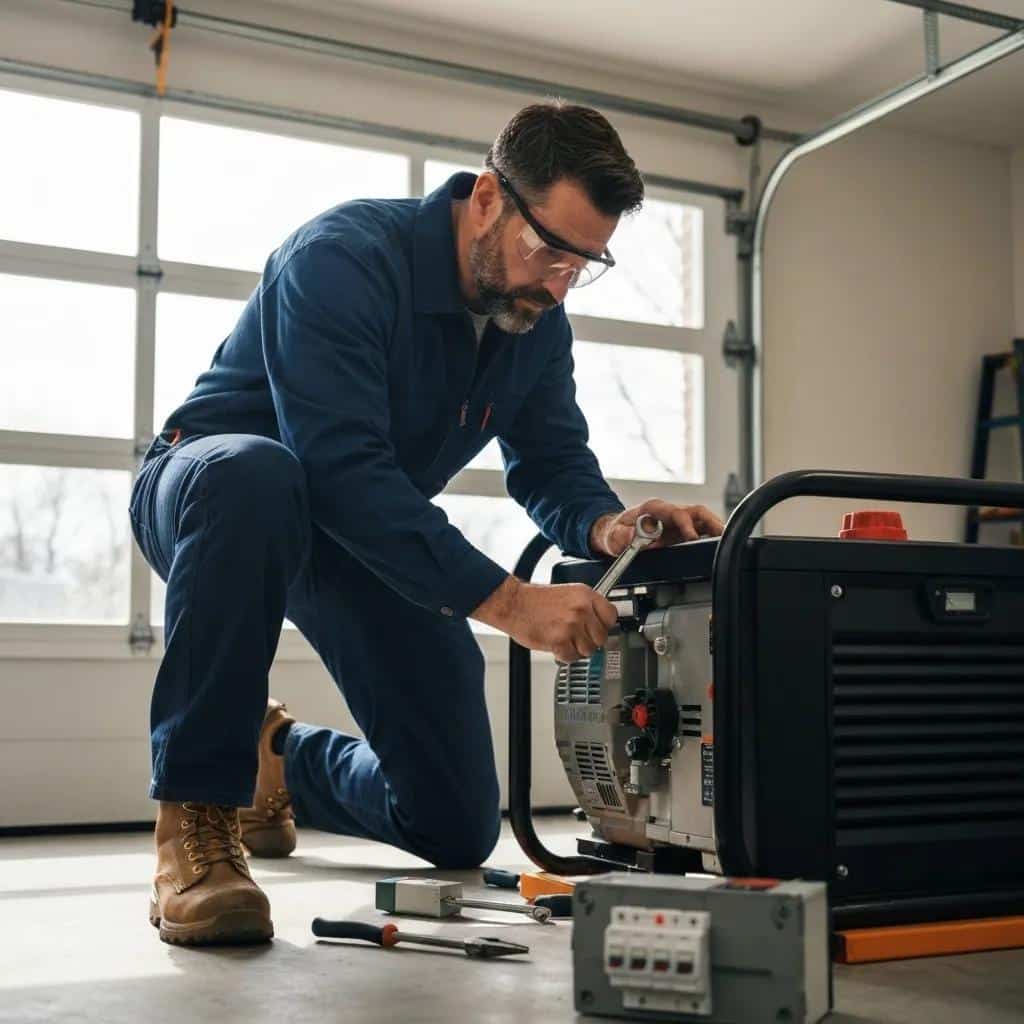
Having a licensed electrician handle your generator installation ensures that your system meets all electrical codes, local permit requirements, and safety standards. They also guarantee reliable startup and proper fuel management. Rewired Iowa’s licensed electricians provide personalized load calculations and on-site assessments to ensure your generator is sized and installed correctly for your specific needs.
What Electrical Codes and Permits Are Involved in Generator Installation in Iowa?
In Iowa, all generator installations must adhere to the National Electrical Code (NEC) Article 702, NFPA 37 standards for installation, and local building department regulations. Permits are required for everything from site preparation and fuel line installation to wiring, transfer switch placement, and noise ordinance compliance—all of which are critical for safe and code-compliant operation.
How Do Licensed Installers Ensure Your Generator is Set Up Safely and Efficiently?
Certified electricians perform detailed load studies, conduct ground fault testing, and calibrate the transfer switch. They meticulously check for proper grounding, conduit runs, and adequate ventilation. After installation, they perform thorough inspections to confirm that the automatic startup sequence works flawlessly and that any remote monitoring configurations are set up for 24/7 reliability.
What Are the Advantages of Turnkey Installation and Remote Monitoring Services?
Rewired Iowa’s turnkey installation service handles all the details, including obtaining permits, upgrading electrical panels, coordinating fuel line connections, and managing the final inspection. This saves you time and ensures a zero-blackout experience. Our remote monitoring platforms keep track of your generator’s health, its regular exercise cycles, and fuel levels, giving you complete peace of mind throughout the year.
What Are the Most Common Questions About Picking the Right Generator Size?
Homeowners often ask how to convert their appliance power needs into kilowatts, which surge capacities are most important to consider, and whether portable units can realistically power central air conditioners. Many also inquire about how to combine energy efficiency improvements with soft-start technology to potentially downsize whole-house generators. Others are looking for clear information on permit requirements and code compliance specifically for Central Iowa. By following the step-by-step load calculation process, utilizing brand-specific sizing tools, and consulting with licensed professionals like those at Rewired Iowa for personalized load calculations and on-site assessments, you can get clear answers to these questions and confidently choose the generator size that best fits your home’s backup power needs.
Selecting the correct generator size is key to preventing overloads, using fuel efficiently, and protecting your home during power outages. By carefully listing your essential power loads, understanding the difference between running and starting watts, and adding a safety margin, you can determine the precise capacity you need. Utilizing brand-specific sizing charts, online calculators, and professional installation services from Rewired Iowa will ensure your system is code-compliant, operates seamlessly, and provides long-term reliability. For homeowners in Central Iowa seeking expert advice and comprehensive solutions, contact Rewired Iowa for a free generator consultation and discover how the right backup power system can bring you true peace of mind.

John Senn is a licensed Master Electrician based in Des Moines, Iowa with over 20 years of hands‑on experience serving homes and businesses across the state. He specializes in electrical panel upgrades, whole‑home generator installations, EV charger setups, and 24‑hour emergency service. As the owner of a growing team of certified electricians, John has built a reputation for safe, code‑compliant work and practical solutions that keep Iowa families and businesses powered up. His deep knowledge of Iowa’s electrical codes and his commitment to ongoing training make him a trusted voice in the trade and a go‑to expert for reliable electrical work in Des Moines and beyond.