
Underground Wiring in Des Moines — Trusted Trenching & Buried‑Cable Services
Underground wiring means running power below grade using either direct bury electrical wire or conduit when overhead lines aren’t practical, safe, or visually acceptable. This guide explains how buried cable and electrical trenching can improve reliability, safety, and curb appeal for properties, and it walks through the practical steps, permitting and code considerations, typical cost drivers, and the questions homeowners and small businesses ask most. Many property owners worry about outages, landscaping damage, or permits; understanding the installation lifecycle—from site assessment and utility locating to testing and final restoration—reduces surprises and helps projects finish on schedule. You’ll learn when underground wiring makes sense, which services are available in Des Moines, a step‑by‑step installation outline, transparent cost factors, relevant NEC and local code points, and answers to common questions so you can compare bids and request an accurate on‑site estimate.
Why Choose Underground Wiring Installation for Your Des Moines Property?
Burying service and feeder lines takes them out of the path of wind, ice, and falling branches—common causes of outages—so underground wiring improves continuity and lowers long‑term maintenance. Conduit and buried cable protect conductors from weather and mechanical damage, and removing poles and overhead lines keeps yards and facades cleaner, which can boost curb appeal and perceived property value. The reduced exposure to hazards also improves by cutting the chance of accidental contact or downed‑wire incidents.
Underground runs are a smart choice when overhead lines would cross large lawns, serve detached buildings like garages or pool equipment, or interfere with long‑term landscaping plans. In Des Moines, local soils and seasonal freeze–thaw cycles make a careful installation strategy important to limit movement and keep conductors reliable. The next section explains the specific services and methods we use to address those local conditions.
Rewired Iowa takes a local, homeowner‑friendly approach to underground projects in Des Moines. As a family‑owned electrical company, we focus on timely, courteous service, transparent pricing, and a 5‑year workmanship guarantee to lower your risk. We’re available 24/7 for urgent issues, hold a BBB A+ rating, and have more than 400 five‑star reviews—signals that help property owners pick a dependable contractor for trenching and buried cable work. For an accurate estimate, contact Rewired Iowa for an on‑site evaluation and a clear pricing breakdown.
What Are the Key Benefits of Underground Electrical Installation?
Underground wiring boosts reliability by removing burial wire from weather and vegetation that commonly cause outages. Burying lines reduces maintenance because fewer components face UV, wind, or falling trees, which extends conductor life. Hidden wiring preserves landscaping and building sightlines and can improve resale appeal. From a safety view, buried systems lower the likelihood of accidental contact, pole failures in storms, and some lightning‑related problems.
Those advantages matter most when the system is sized and protected for its intended use—low‑voltage landscape lighting, a feeder to a detached garage, or power for commercial signage each require different conductor sizes and protections. The next section shows how our translate into better reliability and value on real projects.
How Does Underground Wiring Increase Property Value and Reliability?
Buyers and tenants often treat underground utilities as an upgrade because they signal thoughtful infrastructure and lower visible maintenance. Fewer interruptions mean less downtime for small businesses and less stress for homeowners who rely on HVAC, medical equipment, or other essentials. Inspectors and insurance underwriters generally prefer code‑compliant buried installations, which can influence inspections or policy terms. For properties planning additions—sheds, pools, or outdoor kitchens—installing underground wiring during construction avoids later landscaping disruption and simplifies future work.
When considering an underground project, weigh expected reliability gains against cost and disruption to estimate ROI: fewer outages, lower annual maintenance, and improved curb appeal all add practical and market value. The next section covers the services available in Des Moines that deliver those benefits.
What Underground Electrical Services Does Rewired Iowa Offer in Des Moines?
Below are the underground electrical services commonly provided for residential and commercial projects in , and how each meets typical needs. Rewired Iowa provides electrical trenching, conduit installation, buried cable repair, and fault finding for jobs ranging from landscape lighting to service‑entrance upgrades. Our goal on every job is to meet code, deliver long‑term reliability, and minimize landscape disturbance while handling permits and coordinating utility locates.
Here are common residential and commercial service categories and their typical uses as part of a complete underground wiring solution.
What Residential Underground Wiring Solutions Are Available?
Typical residential projects include powering detached garages, outdoor kitchens, pools/hot tubs, landscape lighting, and accessory structures. Each job begins with a load assessment to size feeders and overcurrent protection—hot tubs or garage subpanels, for example, may require robust 8 3 direct bury wire, while low‑voltage lighting uses different conductors and grounding. We often recommend conduit when future upgrades are likely; for short, protected runs to a shed or outdoor outlet, direct bury 12 2 wire can be cost‑effective, though conduit gives greater long‑term flexibility. Soil type and required burial depth influence the safest, most economical approach. For example, powering a small pump might use direct bury 10 3 wire, selected for its capacity and durability in specific soils. Homeowners can speed accurate on‑site estimates by sharing photos, approximate run lengths, and a list of expected loads, which helps us decide if 10 2 direct bury wire or another gauge is right.
Choosing the correct method reduces future digging and protects against Iowa’s freeze‑thaw movement and seasonal moisture. The next subsection describes small‑business and commercial options that prioritize uptime and regulatory coordination.
How Do Commercial Underground Electrical Installations Support Small Businesses?

Commercial underground work focuses on reliability, code compliance, and minimizing downtime for businesses that can’t afford long outages. Common commercial jobs include parking lot lighting, storefront signage, service upgrades for tenant spaces, and power to outdoor amenities. These projects require coordination with site managers, inspections, and sometimes phased scheduling to avoid disrupting operations. A properly designed underground system improves uptime, reduces service calls, and preserves curb appeal—factors that affect customer experience and employee safety.
Scalable designs let businesses add loads later without re‑trenching; contractors often run conduit or install sleeves for future circuits. The next subsection lists the tasks included in standard trenching and conduit packages and offers guidance on conduit types and burial depths.
What Is Included in Electrical Trenching and Conduit Installation Services?
Typical trenching and conduit packages include site layout and markings, utility locate coordination (811), excavation, conduit placement, pull boxes or handholes as needed, cable pulling, warning tape, backfill and compaction, and surface restoration. Technicians install grounding systems and junction enclosures per code, run insulation and continuity tests, and document the work for inspection. Material options—PVC, HDPE, or metal conduit—are chosen for the site’s environment, protection needs, and future access. Restoration returns turf, gravel, or pavement so the site looks and functions as before.
Below is a comparison table of common conduit options, suggested burial depths, and typical applications to help you choose the right approach.
| Conduit Type | Typical Burial Depth / Use Case | Recommended Application |
|---|---|---|
| PVC Schedule 40 | 18–24 inches for branch circuits; suitable for residential yards | Cost‑effective, corrosion‑resistant choice for most residential runs |
| HDPE (flexible) | 18–30 inches where directional boring is used or in rocky soils | Flexible for boring and long runs; good impact resistance |
| Rigid Metal Conduit (RMC) | 24+ inches in high‑traffic or mechanically exposed areas | Used where added mechanical protection and longevity are priorities |
This table highlights how material and burial depth affect cost, protection, and future upgrade options.
How Does Rewired Iowa Handle Buried Cable Repair and Fault Finding?
We start buried cable repairs with diagnostic locating—using line locators and underground cable tracers to find faults without needless digging—then perform targeted exposure, splice or replacement, and site restoration. Technicians run insulation‑resistance and continuity tests before and after repairs to confirm reliability and provide documented results for inspections. Whenever possible we use localized potholing instead of broad excavation; when repeated faults or aging cable are present, we often recommend replacing the run and adding conduit to prevent future problems.
Working with a contractor who coordinates locating and testing reduces downtime and limits landscaping damage. The next major section walks through the full installation process from consultation to final inspection.
How Does the Underground Wiring Installation Process Work in Des Moines?
A well‑run underground wiring project follows a clear sequence: consultation and planning, utility locating and permitting, trenching or directional boring, conduit and cable installation, testing and commissioning, then restoration and final inspection. Each stage addresses particular risks—planning clarifies load and routing, locating prevents utility strikes, and testing verifies safety before circuits are energized. Knowing the sequence helps homeowners and businesses plan schedules, budgets, and site access.
Below is a numbered summary that sets expectations for timeline and responsibilities.
- Site assessment and load calculations to determine conductor sizes and protection.
- Utility locate (811) requests and permit applications with local authorities.
- Trenching or directional boring, conduit placement, and cable pulling per design.
- Testing (continuity, insulation resistance) and grounding checks; commissioning.
- Backfill, compaction, landscape or pavement restoration; final electrical inspection.
This sequence shows where approvals, physical work, and testing occur; the following sections expand each phase with typical tasks, timelines, and outcomes.
What Are the Initial Consultation and Planning Steps?
The initial consultation includes a site visit, photos, measuring likely run distances, assessing load needs, and a preliminary cost discussion. We check existing service capacity, review planned loads (appliances, motors, lighting), and recommend conductor sizes, conduit types, and trench routes that minimize impact and cost. Planning also identifies obstacles—mature trees, driveways, or underground utilities—that affect excavation and may call for directional boring. Customers can speed the estimate by providing site photos, desired outlet locations, and any utility maps.
Good planning reduces change orders and helps permits and work move faster; the next subsection explains how trenching, installation, and testing happen on site.
How Is Trenching, Installation, and Testing Performed?
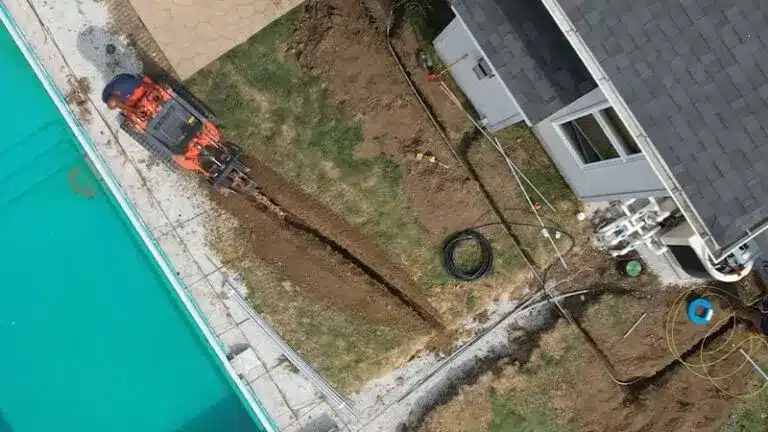
Trenching is done with the appropriate excavation equipment to the specified depth and width, with attention to slope and shoring where required; directional boring is used in sensitive areas to protect the surface. Conduit is set on stable bedding, sweep fittings make pulls smoother, and warning tape is placed above conduits before backfill to alert future excavators. Cable pulling avoids sharp bends and uses lubrication or rollers when needed; splices go in rated junction boxes sealed against moisture. Testing covers continuity, insulation resistance, and functional checks of protective devices—circuits are only energized after they pass all tests.
We provide documented test results and as‑built notes to support inspections and future troubleshooting; the following subsection covers restoration, inspection, and handoff.
What Restoration and Final Inspection Steps Are Involved?
After testing, crews backfill trenches in controlled lifts, compact to prevent settlement, and restore the surface with topsoil and sod for lawns, gravel for driveways, or proper patching for asphalt. Final inspection has municipal or electrical inspectors verify code compliance, grounding, and protective measures; we supply test records and as‑built diagrams to the customer. Most jobs include a final walkthrough to review maintenance tips, the location of buried components, and warranty details. Thoughtful restoration keeps impact minimal and ensures the installation receives final sign‑off.
A clear handoff with paperwork and test documentation reduces future disputes and supports warranty claims if needed.
| Project Phase | Tasks / Requirements | Outcome / Timeline |
|---|---|---|
| Consultation & Planning | Site visit, load calc, preliminary route | Scope and estimate (1–7 days) |
| Permits & Locates | 811 utility locate, permit submission | Clearances for safe excavation (varies by jurisdiction) |
| Installation & Testing | Trench/boring, conduit/cable, testing | Energized, code‑compliant circuit (1–5 days depending on size) |
This table sets expectations for each phase and highlights where time is typically spent on an underground wiring project.
What Factors Influence the Cost of Underground Electrical Installation in Des Moines?
Costs depend on trench length and depth, soil conditions (rock, clay, or roots raise labor and equipment needs), conduit versus direct burial, permit and inspection fees, and how much surface restoration is required. Labor and equipment mobilization for trenching or directional drilling are major contributors, and unexpected obstacles—existing utilities or rock—can add time and cost. Site accessibility (can equipment reach the area or is hand‑digging required?) and the need for specialty or corrosion‑resistant conduit also affect pricing.
- Distance and trench length — more material and labor as runs get longer.
- Soil composition (clay, rock, roots) — affects excavation difficulty and equipment choice.
- Conduit vs direct burial — higher upfront cost for conduit but greater long‑term flexibility.
After reviewing cost drivers, prepare site photos, exact run lengths, and a list of loads to get accurate quotes; the following section explains how to gather information and work with contractors for precise estimates.
Which Elements Affect Pricing for Electrical Trenching and Wiring?

Material choices—conductor type, conduit material, and protective accessories—make up a fixed portion of cost, while labor and equipment time scale with trench length and site difficulty. Permit and inspection fees vary by jurisdiction and add to the total; coordinating utility locates can introduce scheduling costs if multiple visits are needed. Restoration—sod replacement, driveway patching, or concrete repair—often represents a notable part of the final invoice, especially when paved areas are involved. Clear bids that separate materials, labor, permits, and restoration let you compare proposals fairly and avoid surprise charges during the job.
How Can Homeowners and Businesses Get Accurate Estimates?
To get precise estimates, provide contractors with site photos, measured distances for cable runs, descriptions of intended loads, and any available utility maps or as‑built drawings. Request an on‑site visit for a firm quote—remote numbers can miss buried infrastructure or difficult soil. Ask for itemized costs for permits, inspections, and restoration, and include a contingency allowance for unforeseen subsurface conditions. When comparing bids, check references for similar projects and verify warranty terms—especially workmanship guarantees that protect against early failures.
Rewired Iowa emphasizes upfront, fair pricing and a clear estimate process to reduce uncertainty; we provide on‑site evaluations and documented proposals that list scope, permit coordination, and restoration work.
| Project Type | Primary Cost Influences | Estimated Impact on Quote |
|---|---|---|
| Detached garage feed | Distance, conduit choice, load size | Moderate to high |
| Landscape lighting | Low‑voltage cable length, trenching access | Low to moderate |
| Commercial parking lighting | Longer runs, pole bases, inspection requirements | Moderate to high |
What Are the Safety and Code Compliance Requirements for Underground Wiring in Iowa?
Underground wiring must meet the National Electrical Code (NEC) and any local Iowa or municipal amendments. Key rules cover minimum burial depths for different cable and conduit types, conductor ampacity and insulation ratings for wet locations, grounding and bonding for buried equipment, and separation from other underground utilities. Des Moines building departments typically require permits and inspections at specific stages—often trench depth before backfill and a final inspection after commissioning—so early permit coordination helps avoid delays.
What Iowa and National Electrical Codes Apply to Underground Wiring?
The NEC governs burial depth, conductor insulation, and acceptable installation methods for underground conductors; Iowa municipalities often adopt the NEC with local amendments, so confirm Des Moines requirements before work begins. Relevant NEC topics include ampacity adjustments for wet locations, rules for direct buried cable versus conduit, and grounding electrode and bonding requirements. Licensed electricians file permits and present installation details so inspectors can verify compliance; a qualified contractor ensures the design meets both NEC and any local amendments.
Because codes change periodically, confirm current NEC references and Des Moines permitting steps with your contractor before scheduling excavation.
How Does Proper Conduit Installation Ensure Electrical Safety?
Conduit protects cables from mechanical damage, moisture, and pests while making future cable replacement easier without full re‑excavation. Material choice—PVC for corrosion resistance, HDPE for flexible boring, or metal conduit in exposed areas—depends on mechanical and environmental risks. Correct bending radii, sealed fittings in wet locations, and rated pull boxes reduce conductor stress and the chance of insulation failure. Proper burial depth and conduit also lower the risk of accidental contact and give clear cues for future excavators.
Do You Need Permits for Underground Electrical Work in Des Moines?
Yes—permits are typically required for underground electrical work, and inspections usually occur at set stages to confirm safe installation. The usual sequence is permit application and review, utility locates (811), an inspection of trench depth or conduit placement before final backfill, and a final electrical inspection after testing and commissioning. Licensed contractors generally help with permit submissions and scheduling inspections to streamline the process. Securing permits up front prevents costly rework and helps ensure the work is accepted by local authorities.
Hiring a contractor familiar with Des Moines permitting reduces administrative burden and keeps timelines predictable.
What Are the Most Common Questions About Underground Wiring Installation in Des Moines?
This FAQ answers the questions homeowners and small business owners ask most, focusing on local concerns—burial depths, when conduit is needed, who’s qualified to do the work, typical timelines, and repair or upgrade options. Each answer points to sections above for more detail and suggests next steps for getting a site‑specific estimate.
How Deep Should Electrical Wire Be Buried in Des Moines?
Burial depth depends on method and circuit type: direct buried cables commonly need about 24 inches of cover for branch circuits, while circuits in conduit may be allowed at roughly 18 inches depending on conduit type and local code. Low‑voltage landscape wiring usually has shallower depths but still needs protection and warning tape. For temporary needs, a specialized buriable extension cord might be used, though permanent installations always require code‑compliant wiring. Communication lines, such as direct bury coax cable, often have different depth requirements. Frost depth, soil conditions, and municipal rules can change minimums, so verify exact requirements with your inspector or contractor. When in doubt, using conduit and extra depth provides better protection and easier future access.
Do I Need Conduit for Underground Electrical Wiring?
Direct buried cable is acceptable for short, protected runs, but standard direct bury Romex is not suitable for underground use without proper conduit, making conduit the safer choice for many replacements and upgrades. Conduit is recommended when future upgrades are likely, in rocky or high‑traffic locations, or where extra mechanical protection is required; some circuits may also require conduit by code. The decision balances upfront cost against long‑term flexibility and risk. If preserving landscaping or future‑proofing is important, conduit is often the smarter investment.
Who Installs Underground Electrical Lines in Des Moines?
Licensed electricians and qualified electrical contractors install underground lines. Look for proper licensing, insurance, local references, and clear permit handling. Ask for examples of similar work—detached garage feeds, landscape lighting, or signage—and confirm workmanship warranties. A contractor that handles locates, permits, testing documentation, and restoration simplifies the process and reduces coordination for property owners. Always get a written estimate detailing scope, materials, and schedule before work begins.
How Long Does Underground Wiring Installation Take?
Small residential runs can often be completed in a day or two once permits and locates are finished. Larger or commercial projects may take several days to a week depending on trench length, boring needs, and restoration complexity. Permit turnaround and utility‑locate scheduling are common pre‑work delays. Weather and site conditions—frozen or saturated ground—can also extend timelines; smart planning and seasonal scheduling help minimize these impacts. Contractors usually provide a timeline in the written proposal after the on‑site assessment.
Can Buried Electrical Lines Be Repaired or Upgraded?
Yes—buried lines are often located, diagnosed, and repaired with minimal excavation using cable locators and targeted potholing; splices are made in rated enclosures and tested before backfill. If faults recur or cable is aged, upgrading to conduit and pulling new conductors lowers long‑term risk and simplifies future repairs. Upgrades can also include larger conductors or to future‑proof the site. Discuss repair versus replacement with your contractor to balance immediate cost and long‑term reliability.
This article covered benefits, service options, the installation process, cost drivers, code considerations, and common questions about underground wiring and buried cable work in . For a local, on‑site estimate that includes permit coordination, a clear scope with upfront pricing, and a documented warranty, contact Rewired Iowa at (515) 619-5349 or visit our service location at 2612 E 48th St, Des Moines, IA 50317 to schedule an evaluation.
Conclusion
Choosing underground wiring for your Des Moines property enhances reliability, safety, and curb appeal while reducing maintenance costs. Understanding the installation process and available services empowers homeowners and businesses to make informed decisions that align with their needs. For a personalized on-site evaluation and transparent pricing, reach out to Rewired Iowa today. Experience the benefits of professional underground electrical solutions that stand the test of time.

John Senn is a licensed Master Electrician based in Des Moines, Iowa with over 20 years of hands‑on experience serving homes and businesses across the state. He specializes in electrical panel upgrades, whole‑home generator installations, EV charger setups, and 24‑hour emergency service. As the owner of a growing team of certified electricians, John has built a reputation for safe, code‑compliant work and practical solutions that keep Iowa families and businesses powered up. His deep knowledge of Iowa’s electrical codes and his commitment to ongoing training make him a trusted voice in the trade and a go‑to expert for reliable electrical work in Des Moines and beyond.